PROJECT MANAGEMENT PORTFOLIO
Professional Overview
A highly adaptable and proactive Project Management skilled in transforming complex operational challenges into predictable, successful outcomes across multi-disciplinary teams. My approach centers on robust governance, treating risk management as a continuous discipline that proactively mitigates threats across scope, schedule, budget, and quality dimensions, while ensuring all project changes are managed via formalized risk analysis and stakeholder alignment gates. My core expertise lies in transforming unstructured workflows into standardized, efficient processes that drive measurable output and increased team capacity. I specialize in full project life cycles—from defining clear goals to building scalable frameworks. Whether establishing specialized departments from scratch or co-leading large-scale content pipelines across multiple disciplines, my approach prioritizes structured communication, robust risk mitigation, and continuous process refinement.
Core Competencies
Project Scheduling & Milestone Planning
Cross‑Functional Team Leadership
Agile & Scrum Methodologies
Risk Identification & Mitigation
Vendor & Stakeholder Management
Process Optimization & Workflow Design
Resource Coordination
Change Control & Scope Management
Technical Documentation
Communication & Status Reporting
Tools & Platforms
Miro • Confluence • Azure • Jira • MS Teams • Scrum • Team City • Slack • Perforce • MS 360 • Google Workspace
Process philosophy
My approach to solving complex organizational problems isn't about output; it's about optimizing the process. By establishing clear alignment and shared understanding to cross-discipline teams, we unlock sustainable productivity improvements paired with dramatically higher team satisfaction. At the heart of my practice is a simple, powerful inquiry: What do we want? Why do we want it? How will we get there? Every project begins with an obvious answer to "What"—the goal itself. But I argue that the true source of power lies in clarifying the "Why." The stated objective must always be supported by a compelling, deeply understood rationale. When you achieve absolute clarity on why this project matters, the parameters for success ("What") become clear, and the execution roadmap ("How") naturally follows. It is this strategic pairing of Purpose and Scope that transforms ambiguity into decisive action.
Communication Strategy
Effective communication between teams comes from an understanding of the processes and outcomes of each group. As a project manager I prioritize facilitating communication for critical updates, feedback, and exchanges of ideas. Here are some key ways I foster communication:
Daily standups should be centered around individuals and teams that need real time information in order to achieve a stated objective. The goal of a standup is to be informative, focused, and most of all, short.
Weekly Stakeholder updates center around checking goal alignment, signing off of objectives, and delivering high level feedback.
Establishing best communication practices with clear escalation paths for issues that arise.
Facilitate retrospectives that give teams the tools to better themselves by fostering a climate of action and accountability.
Risk Management
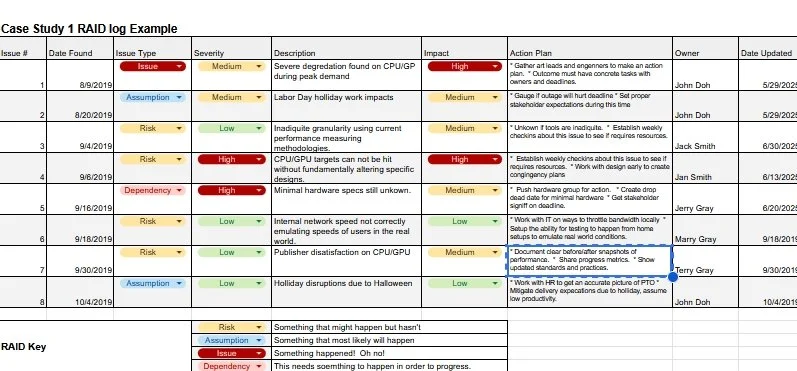
My philosophy to risk management is simple: identify early, quantify honestly, communicate clearly, and mitigate proactively. If you do these four things well, surprises stay small and projects stay predictable. I treat risk management as a continuous discipline, not a phase. I build risk identification into weekly standups, milestone reviews, and cross‑functional syncs to ensure issues surface early.
I evaluate risks across four dimensions, Impact on scope, schedule, budget, and quality.
I create structure to pull risks from engineering, art/creative, QA, vendors, and leadership to avoid blind spots.
I produce proactive mitigation plans: For each risk, I define an owner, a mitigation action, and any relevant trigger conditions so warning signs can be identified.
I flag upstream/downstream impacts so teams understand the real cost of a missed dependency.
I create regular risk reports so leadership always knows the current threat landscape.
Dealing with Change
Change is inevitable when managing large complex projects. Ensuring a team has the proper tools to enact and react to change is a major factor that separates high functioning teams from others.
Having a formalized change request workflow.
Doing proper Impact analysis (scope, schedule, resources) of any proposed change.
Ensuring stakeholder approval gates for proposed changes.
Stakeholder Alignment
Stakeholder alignment is the key component for project success or failure. To ensure full transparency I prioritize:
Clear expectations that are set at project kickoffs.
Goal alignment through project lifetime.
Regular check‑ins with leads and department heads.
Transparent communication of risks and tradeoffs.
Maintaining simple project dashboards so all can see project status at a glance.
Case Studies:
CASE STUDY 1 — Product Performance & Structural Inefficiencies
Role: Lead VFX Artist (Functioning as Project Manager) Team: 8 developers (art, engineering, design, production, QA) Timeline: 3 months
Project Overview
Directed efforts to overhaul artistic and technical pipelines, resolving long-standing production issues related to improper asset management, staffing shortcomings, workflow inefficiencies, and tech debt. The guiding metrics to project success or failure was CPU/GPU performance metrics set forth by directors.
Responsibilities
Identifying inneficiencies
Lead efforts to profile GPU/CPU performance metrics.
Assessing severity, risk, and cost of content & production related issues.
Planning necessary content overhauls to address performance.
Implementing & Documenting standards and practices.
Project structure & Depot management.
Naming conventions & Asset allocation.
Manage schedules for artists, vendors, and QA.
Coordinating stakeholder feedback.
Challenges
Aggressive performance targets.
Software instability affecting downstream teams.
High volume of variables that contribute to overall inefficiencies.
Legacy Tools.
Undocumented Behavior.
Project Management Approach
Created a framework for testing and identifying Performance issues.
Implemented clear standards and practices for individual asset creation.
Created clear targets for performance and optimization.
Introduced performance related workflows in Jira.
Implemented and managed daily, weekly, and bi-weekly meetings between stakeholders and team members.
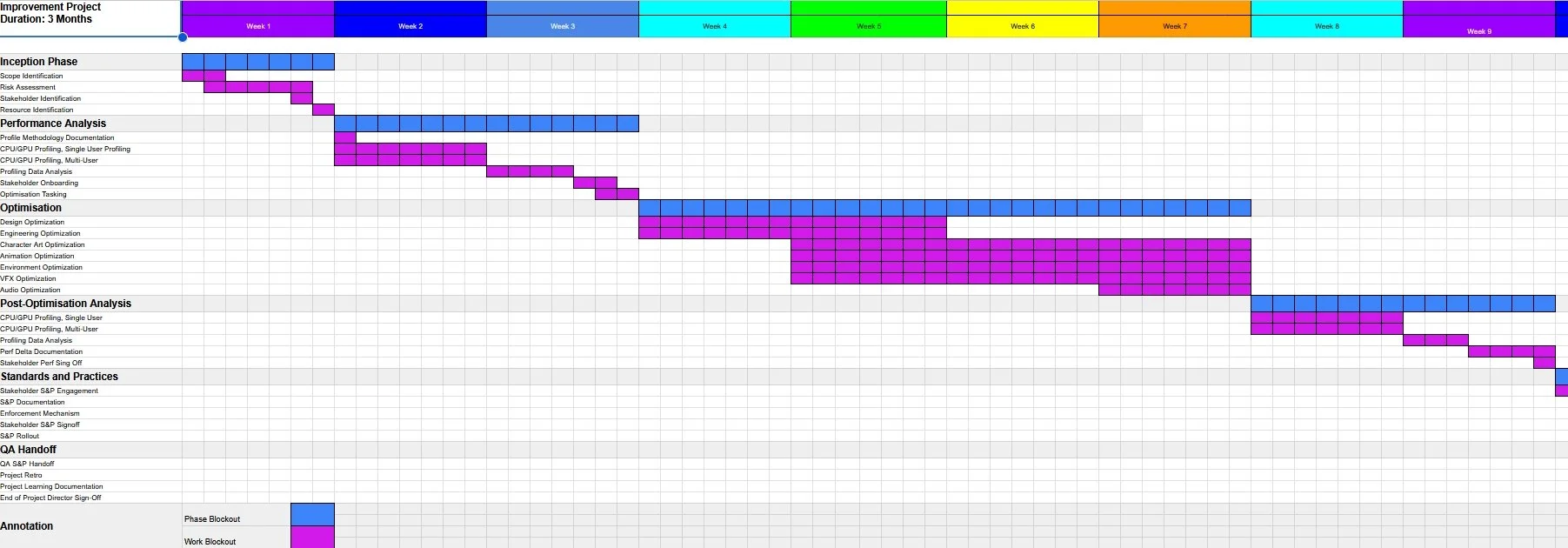
Rebuilt milestone schedules based on realistic performance goals agreed upon by stakeholders and team leads.
Outcomes
Achieved all performance targets for CPU/GPU rendering.
Reduced global asset footprint by eliminating redundancies.
Increased adoption of efficient workflows through documentation & training.
Improved cross-team collaboration.
Structural reforms & optimisation for asset depots.
Artifacts/Examples
Example Gantt chart
Example RAID Log
Critical Path Example
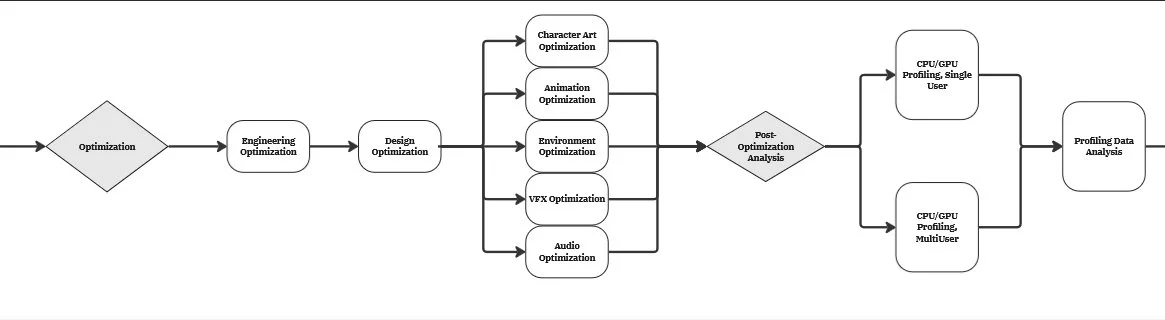
Full viewable version: https://drive.google.com/file/d/1QmakbCU7AAGJ8n7Tzc5M8Muanp1KYMvi/view?usp=sharing
SCRUM Breakdown
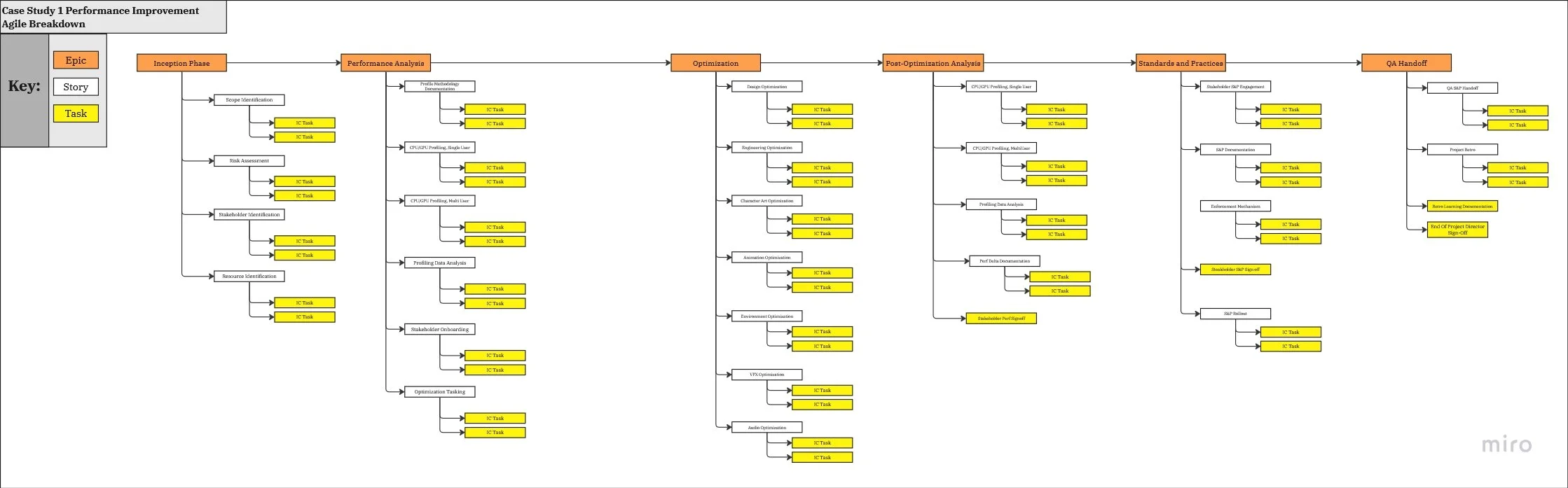
Full viewable version: https://drive.google.com/file/d/1pR-jSw-dgn9cKo1jAc_EQLNobVp11pJL/view?usp=sharing
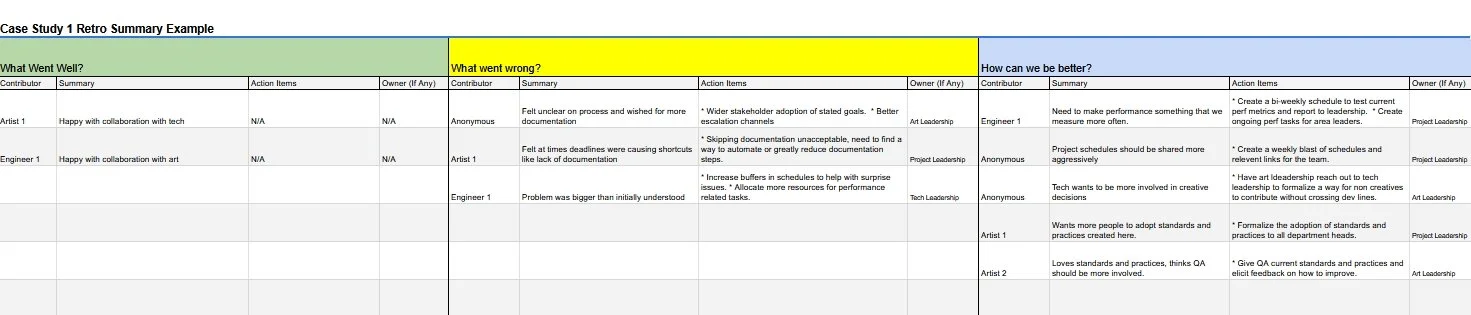
Retro Example
CASE STUDY 2 — Cinematic Department Creation
Role: Lead VFX Artist (Functioning as Project Manager) Team: 12 developers (art, engineering, production, QA) Timeline: 2 months
Project Overview
Managed the creation of a ground up cinematics team. The goal was to create an internal cinematics department capable of building, implementing, and ultimately shipping cinematics for the title Towerborne. Project success would be measured by the on-time delivery of cinematic sequences that meet quality standards set by directors.
Responsibilities
Coordinated stakeholder expectations and timelines.
Production pipeline implementation.
Managed stakeholder feedback and delivery expectations.
Maintained production schedule and burn‑down charts.
Facilitated daily standups and weekly reviews for team members.
Implemented structural standards and practices for cinematic creation.
Risk management and mitigation.
Ensured alignment between documentation and QA.
Final delivery of completed cinematic assets.
Challenges
Compressed timeline due to vendor delays.
No previous internal specialist for vendor work.
High volume of notes requiring rapid iteration.
Lack of publisher faith in the internal team ability.
Project Management Approach
Create clear targets based on time, resources, and stakeholder goals.
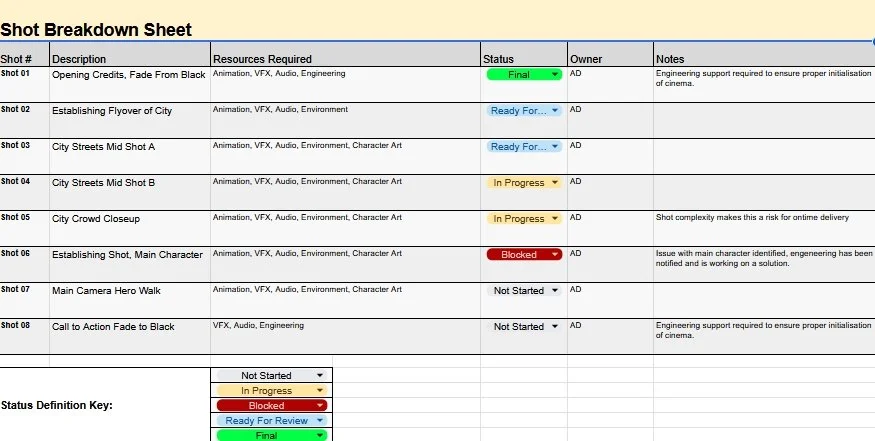
Created shot breakdowns that documented risks, complexities, and contingencies.
Standardized feedback pipeline to reduce turnaround time.
Reorganized the team into strike teams to increase throughput.
Implemented Azure task management workflow.
Facilitated cross-team feedback Miro & Azure boards.
Outcomes
Delivered all cinematic assets meeting or exceeding director quality standards.
Standardized feedback loops strengthened cross-team communication and alignment.
Filled a specialized skills gap by creating a cinematics department.
Saved company money by eliminating the need for expensive 3rd party vendors.
Increased team creative capacity.
Artifacts/Examples
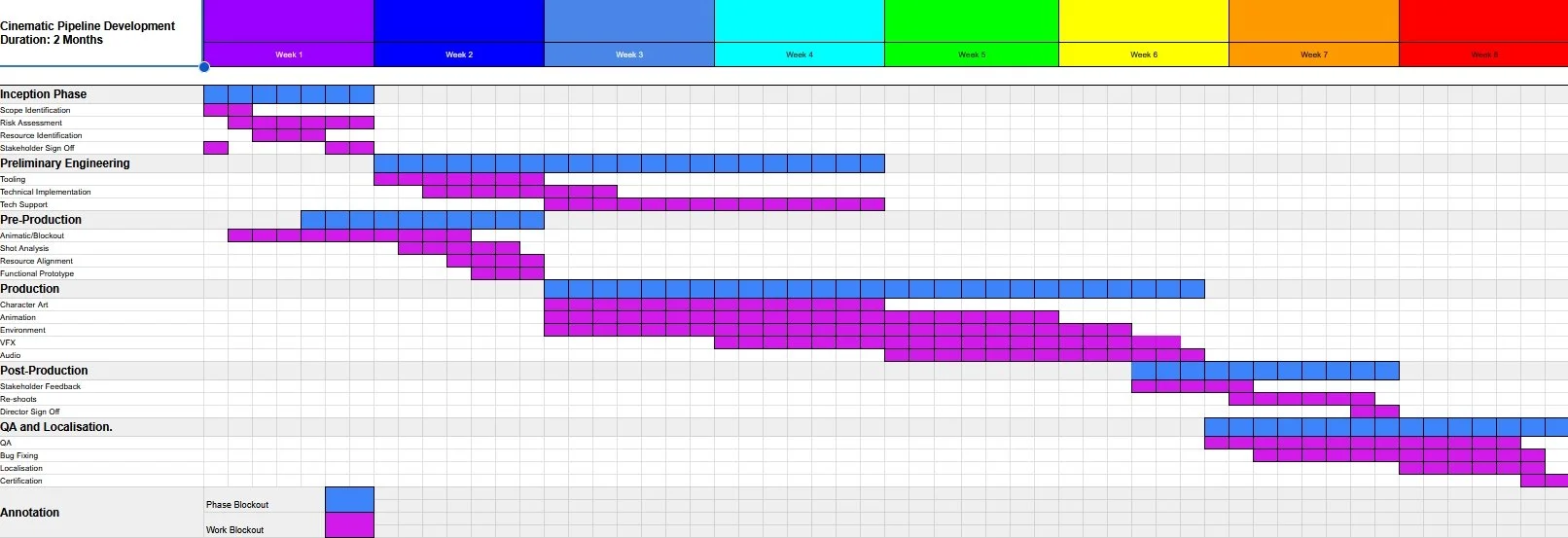
Example Gantt chart
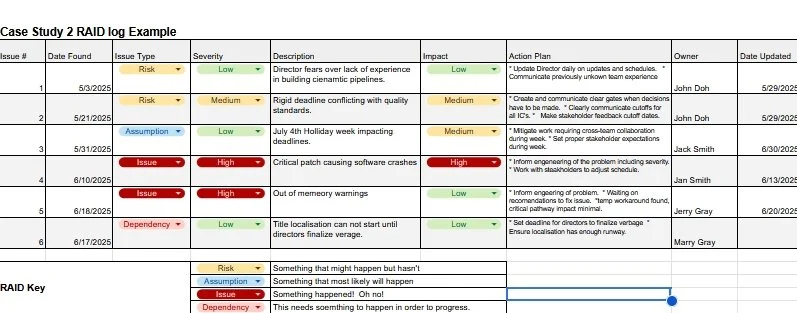
Example RAID Log
Shot Breakdown
SCRUM Breakdown
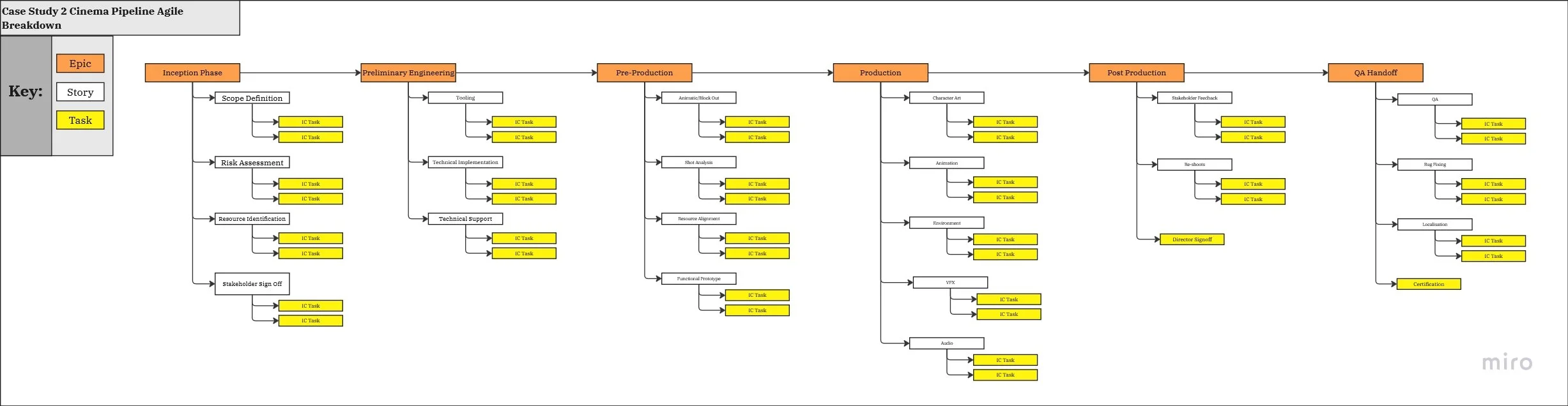
Full viewable version: https://drive.google.com/file/d/1ggJLpiQ4dGEW04_Z_GuW2GgF_5XdHncC/view?usp=sharing
CASE STUDY 3 — Combat Feature Pipeline & Framework
Role: Lead VFX Artist (Functioning as Co-Project Manager) Co-Managers 3, Team: 16 developers (art, engineering, production, QA) Timeline: 6 months
Project Overview
Co-Led the creation, implementation, and supervision of the combat content pipeline for the game Towerborne. The goal was to create an asset pipeline framework that would allow small strike teams to operate efficiently and independently while maintaining focused director feedback loops. Project success would be measured by the smooth, on-time delivery, of combat assets to directors through the project lifecycle. Successful integration of documentation into QA standards and practices was also a critical measure of success. All while fostering positive strike team satisfaction and morale by creating a framework that ensures team members have a sense of ownership and the ability to affect change.
Responsibilities
Worked with Co-Project Managers on areas of ownership and best cross-team communication practices.
Defined scope, requirements, and success criteria.
Built project schedules and sprint plans.
Coordinated engineering and art requirements.
Facilitated weekly demos and formal director sign off.
Documented processes and trained team members.
Ensured clear exit criteria for tasks with QA.
Challenges
Scale and Complexity require multiple departments working in tandem.
Project parameters had to scale for large and small content tasks.
Conflicting priorities between engineering, design, creative, and publishing.
High volumes of individual specialists needed for content completion.
Multiple levels of internal and external stakeholders.
Different teams had different task management needs.
One size fits all approaches not possible.
Project Management Approach
Conducted stakeholder interviews to align priorities.
Co-Authored Miro boards to clarify ownership.
Used Scrum style sprint planning & retros.
Created visual tracking methodology for artists and designers.
Helped implement Azure task tracking for QA & Tech.
Ensured transparency and communication with directors and stakeholders.
Outcomes
Creation, implementation, and supervision of the combat content pipeline framework for the game Towerborne
Empowered individual strike teams to work efficiently and independently.
Leveraged the content pipeline framework to ship hundreds of pieces of content to grateful users.
Retros and ongoing pipeline refinement led to measurable increases in team productivity.
High levels of stakeholder and director satisfaction.
Artifacts/Examples
Example Gantt chart
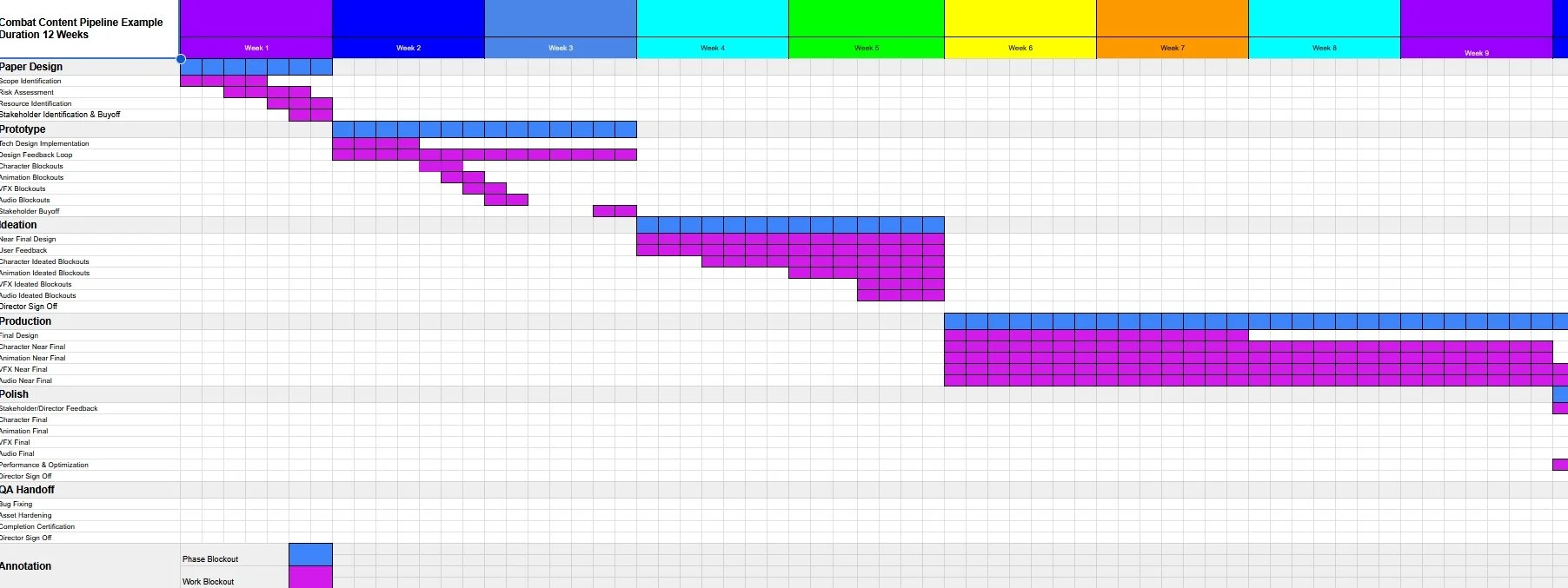
Example RAID Log
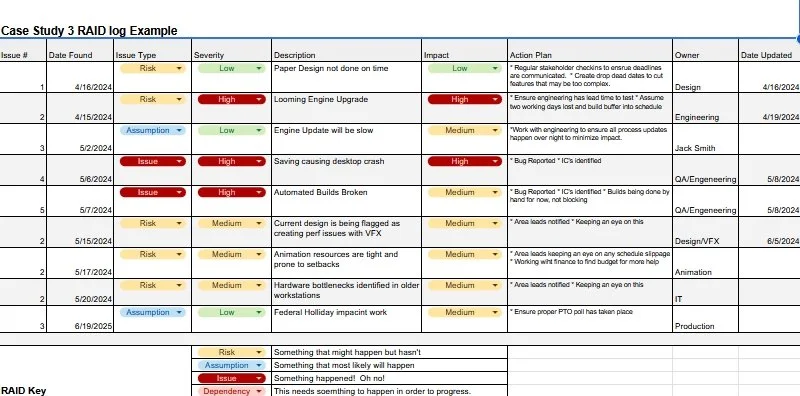
Critical Path Example
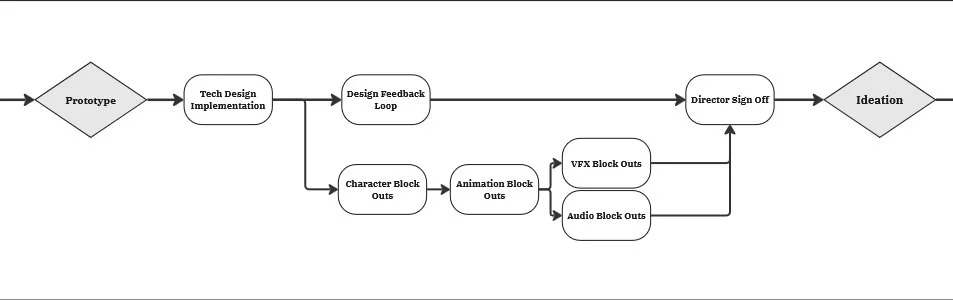
Full viewable version: https://drive.google.com/file/d/1fX1YUsTagE1KBOrBaYBnCnhPeGwRwQVM/view?usp=sharing
SCRUM breakdown
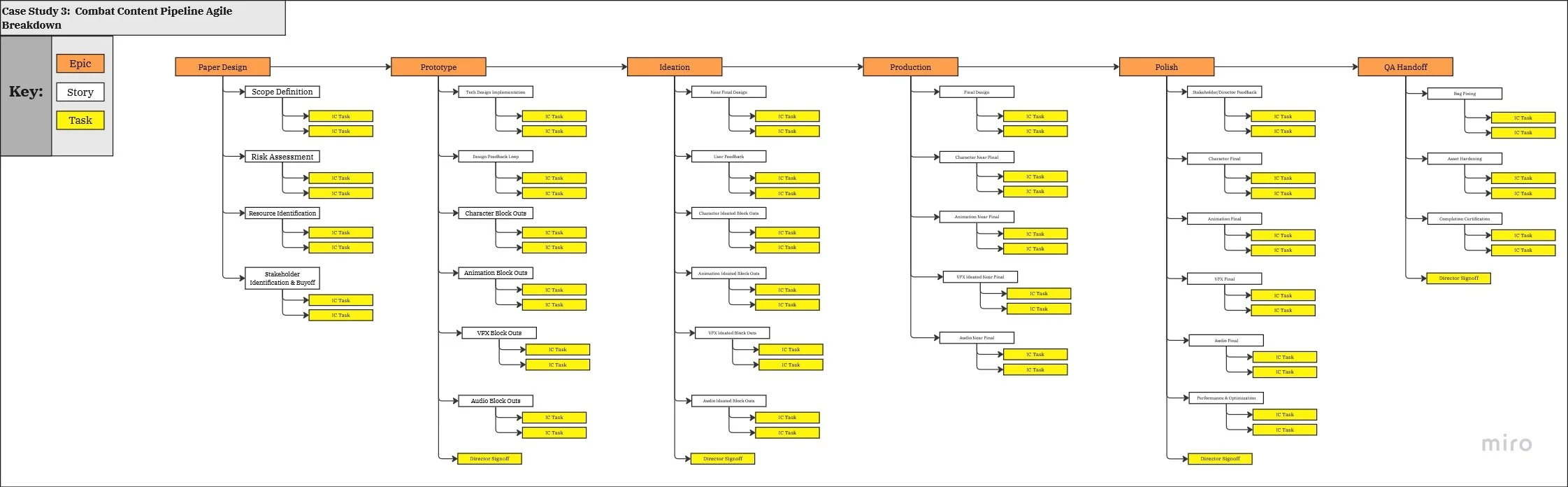
Full viewable version: https://drive.google.com/file/d/1rpoo3EaaGJjD2w3ynHWMrm4Ex1kSDMEH/view?usp=sharing